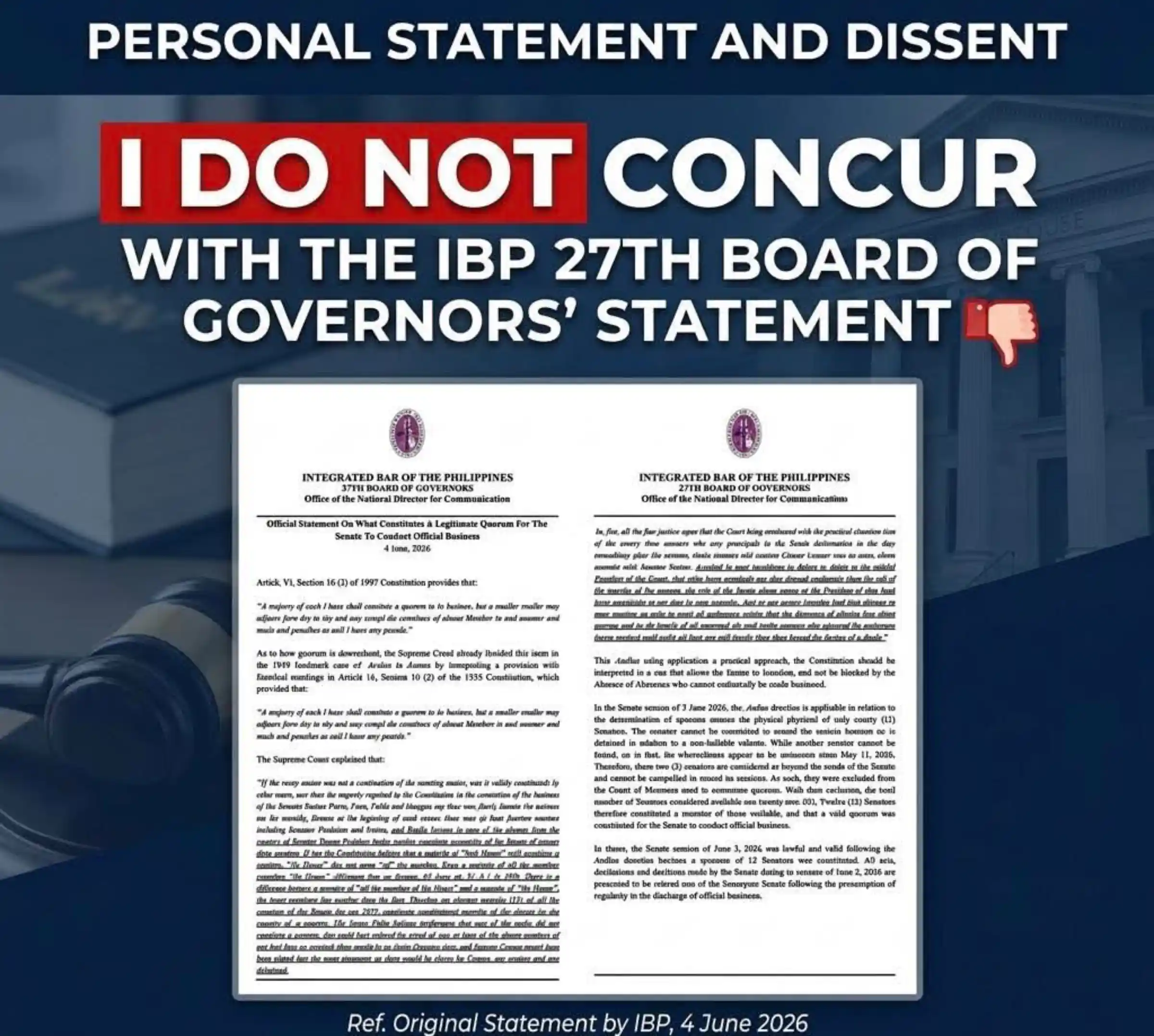
As a member in good standing of the Integrated Bar of the Philippines (IBP), I write to respectfully submit that the recent statement issued by the 27th Honorable Board of Governors regarding the June 3, 2026 Senate quorum should not be construed as the collective or consensus position of the entire IBP membership.
Because this matter was not subjected to prior consultation with the general membership, the statement properly reflects the perspective of the Board rather than the unified stance of the organization's constituents. Consequently, it does not necessarily represent my personal views or those of numerous other members of the Bar.
In this regard, it is my considered personal legal opinion that no valid quorum was constituted during the proceedings in question, and consequently, Senator Win Gatchalian was not validly elected as Senate President Pro Tempore, nor were the "new" committee leaderships lawfully established.
In light of the profound constitutional implications of this controversy, I earnestly implore the public and my colleagues in the legal profession to exercise rigorous factual and legal verification before drawing conclusions. In an era where complex political maneuvers are easily oversimplified, it is incumbent upon us to look past mere rhetoric, critically examine established jurisprudence, and anchor our understanding strictly on the text of the Constitution.
Salient Legal Position and Summary
To properly contextualize this matter, I submit the following summary of the legal principles demonstrating that the Senate session on June 3, 2026, lacked constitutional validity and that the landmark ruling in Avelino v. Cuenco (1949) is entirely inapplicable:
1. The Factual Inapplicability of the Avelino Exception
The Supreme Court recognized a narrow, exceptional quorum in Avelino based on strict factual pillars that do not exist in the present controversy:
Initial Majority: The Avelino session opened with an undisputed majority of 14 senators before dwindling to 12. The June 3 session was initiated by exactly 12 senators, never meeting the baseline majority.
Absence from Jurisdiction: In Avelino, a senator was physically outside the country, legally reducing the active composition to 23 (making 12 a majority). On June 3, no sitting senator was outside the jurisdiction of the Philippines.
Compulsory Processes: The Avelino bloc exhausted constitutional remedies by attempting to compel the attendance of absent members. In contrast, the 12-member bloc on June 3 made no such attempt and swiftly adjourned, actively preventing the participation of the remaining members.
Under the doctrine of stare decisis, a precedent applies only if the facts are substantially the same. Because the foundational facts in Avelino are absent on the June 3 Senate session , the general rule governs: the Senate is composed of 24 members, and a constitutional quorum strictly requires 13 members.
2. The Altered Constitutional Framework for Elections
The Avelino ruling allowed a minority of 11 votes to elect leadership because it was governed by the 1935 Constitution, which did not require a majority of all members to elect officers.
Conversely,Article VI, Section 16(1) of the current 1987 Constitution explicitly mandates that the Senate shall elect its officers by a majority vote of ALL its respective members.
3. Conclusion and Status of Senate Leadership
Because the 12 senators present on June 3 lacked both the quorum to conduct business and the minimum 13 votes required by the 1987 Constitution to reorganize the chamber, all acts performed during that session are null and void ab initio (from the beginning):
No Quorum & Void Acts: The June 3 session was unconstitutional; therefore, all resolutions passed and reorganizations attempted carry no legal authority.
Incumbent Leadership Unchanged: Senator Alan Peter Cayetano remains the legitimate Senate President. Concurrently, the incumbent Senate President Pro Tempore, Senate Secretary, and Sergeant-at-Arms remain unchanged in their respective offices.
Committees Intact: All standing Committee Chairs and memberships remain entirely unaffected. Senator Win Gatchalian holds no lawful title as Senate President Pro Tempore or Acting Senate President.
Need Legal Guidance on Constitutional or Public Law Matters?
Codilla Law provides counsel to individuals, families, and businesses navigating complex legal questions across family law, property, criminal defense, contracts, labor, and civil claims.
Schedule a confidential consultation through this page or send an inquiry to contactus@codillalaw.com.
Disclaimer: The legal insights and opinions expressed in this piece are the personal views of the author and do not represent the official stance of any affiliated academic institutions or organizations. Content is shared for discussion and educational purposes only. It does not constitute legal advice and does not create an attorney-client relationship. For specific legal concerns, readers should consult independent counsel.